
Reeves County Most Wanted Status
Reeves County publishes no most-wanted list. The Sheriff's Office offers no warrant-search portal. There is no wanted-person count, no photo page, and no update schedule. That gap invites bad information. An unverified site might carry a stale list, one lifted from another county, or a name matched to the wrong person. None of it can confirm that someone is wanted in Reeves County right now.
Does the absence prove anything? No. It only means there is no county list to browse. A warrant may still exist. For a local question, start with the Sheriff's Office or its Criminal Investigation Division. For a case question, go to the clerk who holds that court record. Keep the two paths separate. A case result is never automatic proof of a warrant.
Official Reeves County Tip Channels
For crime tips, the Sheriff's Criminal Investigation Division is the local official channel. Call the CID hotline at (432) 287-0321. The Sheriff's Office general line is (432) 445-4901. Treat these as contact and tip lines, not as a way to confirm that a named person has a warrant.
Reeves County Sheriff’s Office Criminal Investigation DivisionCrime-tip hotline: (432) 287-0321
General Sheriff’s Office: (432) 445-4901
Safety first. Do not approach, follow, confront, or try to detain anyone over a rumor, a search result, or a wanted notice. Immediate danger means call 911. For everything else, hand what you know to the Sheriff's Office or CID and let trained personnel decide the response.
Stick to what you actually saw. Give a location, a time, a vehicle description, or a direct link to whatever raised the concern. Resist spreading a name or photo as a local wanted claim. The agency can weigh your tip against its current records. That is verification the public cannot safely do from an unofficial page.
Texas DPS Wanted Records, Not a County List
The Texas DPS Still Wanted page is the statewide fallback. DPS publishes the profiles, photographs, tip instructions, reward information where applicable, and its own safety warning for entries it chooses to place in that statewide system. A DPS entry is not a Reeves County roster, and a person absent from that page should not be treated as cleared of a local warrant.
The distinction is practical. DPS has a statewide publication process and can supply a source date and agency attribution for its own entries. Reeves County did not have an equivalent public page in the research. When checking a page, read the issuing agency and its current status language rather than assuming that every wanted record in Texas appears in one list.
The statewide Texas Crime Stoppers directory can help locate a participating program, and the statewide tip number is 1-800-252-TIPS (8477). The research did not verify a Reeves-specific Crime Stoppers organization or a local reward offer. Do not promise anonymity, a reward, or eligibility for a reward beyond the terms published by the route used.
The Texas Crime Stoppers directory is the official state directory route represented in the image, not a Reeves County wanted list.
The directory offers a careful handoff to an official tip channel without pretending Reeves County has a verified local program or roster of its own.
Note: A statewide tip route can help you report, but only the receiving agency can say whether the information matches a current Reeves County matter.
Verify a Reeves County Warrant
A warrant question demands a current source with a real source date. Start with the Sheriff's Office for law-enforcement status under its own procedures. To trace a court case, two clerks cover the ground. The Reeves County Clerk handles misdemeanor criminal-record services. The Reeves County District Clerk handles felony cases. Fees differ slightly between them. The County Clerk charges $10 for a name search, $1 per page for copies, and $5 for certification. The District Clerk lists a $5 name search, $1 per page, and $5 for certification.
Clerk channels surface case records and outcomes where they exist. They do not settle whether a warrant is active. Texas Courts guidance confirms there is no single portal for every trial-court case in the state. The right county, district, justice, or municipal court may need a direct call. A Pecos municipal matter can run through the municipal court as its own path. Ask the record custodian what the file actually means. Do not read a charge, or a missing result, as a final status decision.
- Write down the exact name, the jurisdiction, and the current source date behind the concern.
- Use the official Sheriff’s Office or CID route for a local safety tip or status question.
- Use the County Clerk for a misdemeanor case path or the District Clerk for a felony case path.
- Use the DPS system only for a statewide wanted profile, and preserve its issuing-agency information.
- Let the agency, court, or an attorney address the legal status. Do not rely on a commercial warrant page as confirmation.
Note: A clerk search can locate a case record, while only the sheriff or the court can say whether a warrant stands active at the time you ask.
Reeves County Wanted Fields to Verify
Reeves County has no official published wanted list. So there are no fields to copy. If the county puts one out later, read the publication itself for its verification points. Treat anything else as unverified.
| Check on the official page | Why it matters |
|---|---|
| Name and source agency | Shows who issued the entry and reduces the risk of a mistaken identity claim. |
| Publication or update date | Shows whether the status could be current enough to act on through the agency. |
| Photo attribution | Distinguishes an agency-published image from an unattributed copy. |
| Warrant, case, or alleged-offense language | Clarifies what the source actually says without turning an charge into a conclusion. |
| Tip, reward, and safety terms | Identifies the official reporting channel and any limits attached to a reward. |
Watch for a few warning signs before trusting any list. Missing source attribution is one. No statement about current status is another. So is the lack of a safety notice. All point to an unverified page. A list like that has no place on a local wanted page. It should also never be used to identify someone in public.
No Reeves County Wanted App Was Verified
The Reeves County Sheriff's Office has no mobile app. Not for wanted notices, booking photos, or arrest alerts. Reeves County Emergency Management and the Pecos Alert Center handle emergency notifications only. They do not verify warrants. The Town of Pecos civic app is a general city-services tool, not a sheriff's wanted-person system.
That distinction matters. Subscribing to emergency alerts, or a statewide victim-status service, does not give you a public wanted feed. To learn whether someone is in county custody, check the dated official custody report. For older booking material, send a written records request. A later appearance on the county roster can show custody after an arrest, but it is not an answer on current warrants. The county report is a custody snapshot with booking and agency fields, not a warrant database. Read its date range and generation time before drawing any conclusion from an entry or a gap. There is no fixed update schedule or booking-alert subscription. Direct current questions to the sheriff.
Correcting a Reeves County Online Record
Suppose an online page wrongly ties a person to a warrant or arrest. Save the direct URL first. Then gather proof from the court or agency that holds the real record. The DPS error-resolution guidance says one thing plainly: DPS cannot force a private website to change its copy. So use the publisher's own correction process. When that falls short, a lawyer can advise on expunction, nondisclosure, or another court order that fits the situation.
The official DPS error-resolution page shown in the image marks the gap. Fixing an agency record is one thing. Changing a separate publisher's page is another.
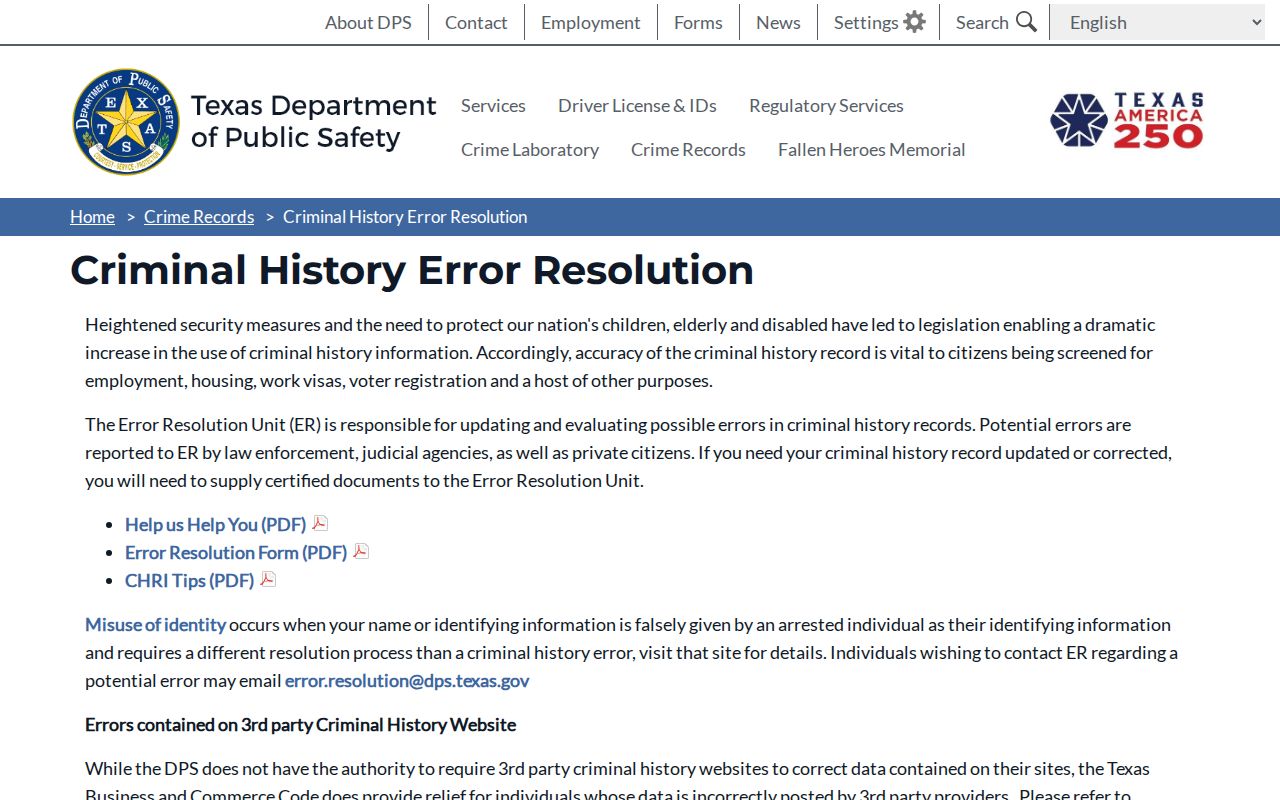
A Reeves County warrant question still starts with the sheriff, the clerk, the court, or an attorney. An outdated online claim is no safe stand-in for that step.
Note: An error in a private online copy does not by itself change the status of a Reeves County court or law-enforcement record.
Reeves County Wanted, Booked, and Convicted
A wanted listing, a charge, and an in-custody entry are different stages. A warrant is formal legal authorization, and its type and current status must come from the right court or law-enforcement source. When a Reeves County arrest leads to county custody, the official in-custody report shows the booking date, custody status, arresting agency, charge text, and bond details tied to that report's date. The final outcome lives in the court record, not the report.
For state-prison custody after sentencing, use the Texas Department of Criminal Justice inmate locator, which is a separate system. Federal and immigration custody run through the Bureau of Prisons locator and the ICE locator. Someone missing from the county report may have been released, transferred, or held elsewhere, since a dated snapshot has limits. Absence proves nothing about whether an arrest or warrant ever existed. The Reeves County custody and records guide covers the dated in-custody source and the official request path for booking material.